
Ecuador, March 2018
María Chacaguasay – Otavalo
Luz María- Otavalo
Elena Ramos- Otavalo
María Sanchez- Otavalo
Desplazarse por las cinco o seis manzanas que ocupa el mercado de artesanías puede llegar a ser un desafío no solo por la multitud de gente, sino también por la gran cantidad de puestos esparcidos en forma irregular. Sin embargo, la amabilidad de la gente, la energía de los vendedores así como los diferentes ritmos de música que pueden oírse por radios y altavoces hacen del corazón del pueblo una animada fiesta en la que no se puede dejar de participar.
La belleza de las otavaleñas y su vestimenta tradicional le dan al espacio una magia singular: faldas azules de entramado de telar, una blusa blanca primorosamente bordada y una faja multicolor. El renegrido cabello largo, atado con una cinta de lana de vivos colores, resalta el brillo de los collares de mostacillas y aretes de plata. Muchas de las vendedoras, en particular las de mayor edad, hablan quechua como primera lengua y tienen un mínimo conocimiento del castellano.
La Plaza de los Ponchos se reserva exclusivamente para la venta de artesanías, mientras que en los alrededores de la plaza se venden una infinidad de productos, algunos de producción artesanal, otros de fabricación industrial. Al igual que en otros mercados de artesanías indígenas América Latina, entre los objetos hechos a mano localmente, se ven algunos manufacturados en China. Son varias las vendedoras que comentan que las empresas chinas, en los últimos años, han comenzado a copiar las artesanías otavaleñas para venderlas en el exterior como originales. También muchas de ellas confiesan haber perdido sus hijos a la migración a Europa o a los Estados Unidos, donde se ganan la vida vendiendo la artesanías manufacturadas por sus familiares. Algunas de ellas mismas han cruzado las fronteras, llegando hasta México en busca de clientela, sin embargo, al poco tiempo han regresado a Ecuador debido a que el cambio del peso a dólar, no les compensa el costo y el esfuerzo del viaje.
Otra gran atracción es el mercado de mercado animales que funciona exclusivamente los sábados desde las cuatro hasta las once de la mañana. Allí asisten los habitantes del área de Imbarabura y provincias cercanas para vender y comprar vacas, caballos, cerdos, todo tipo de aves y los muy apreciados cuyes (o cobayos), que son parte de la dieta de los habitantes de la región andina. Además se pueden adquirir recados, lazos, monturas, granos y forraje. A lo alto de una loma próxima al área de venta de animales se encuentran varios de puestos de comida, estratégicamente situados para atraer con el olor a guiso a los transeúntes. El menú consiste en una variedad de platos tradicionales del país: locro, encebollado, cuy asado y patacones (o tostones).
Otavalo es una de las imperdibles atracciones del Ecuador. Más allá de la belleza única de sus artesanías, el mercado es una manifestación tangible de la riqueza étnica y cultural de la diversa sociedad andina y de los pueblos que han sabido mantener sus tradiciones gracias a la persistencia y sabiduría de las mujeres y los hombres indígenas. Los artesanos otavaleños, a través de su arte y sus costumbres milenarias, rescatan una genealogía del ser latinoamericano que se yuxtapone al consumismo y producción masivos de la globalización.
María Elena Cotacachi- Otavalo
Guatemala, March 2018
Doña Juanita – Chichicastenango
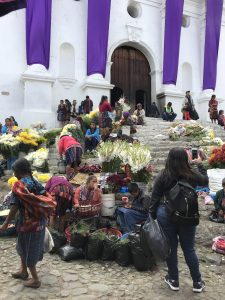 Chichicastenango is one of the most famous indigenous markets in Latin America. It is mentioned in all the travel guides for Guatemala, and visitors always return home with the impression that it is a “must visit” place. But the fact that it is a well-known market does not mean it has lost its authenticity. In Chichicastenango, tourists and local people who sell, buy, eat, and walk the market are all together in a blend of visible and spontaneous activities.
I entered the market zone early in the morning, before 9 a.m., through the side street of the Santo Tomás de Chichicastenango church, and as I was fortunate enough to be there during Lent, I was witness to a an astonishing display of flowers, candles, “ofrendas,” and altars that are traditional during this part of the Catholic calendar.
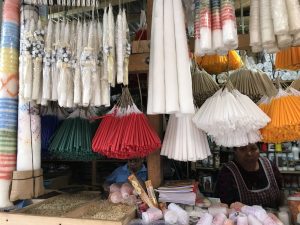 The activities inside the church and in the surrounding areas are an example of the religious syncretism that is prevalent in this area of the Guatemalan Maya world. I returned to the church twice during the day just to sit and be a witness to the ceremonies and celebrations.
The market area around the church is crowded with stands that sell the necessary elements for “ofrendas.” The rest of the market is divided into areas that feature textiles, crafts, fruit and vegetables, meats, food stalls. In the peripheral streets surrounding the market, there are live animals for sale.
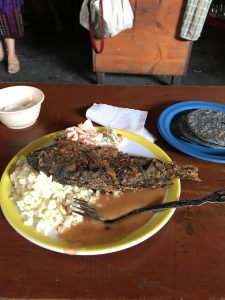
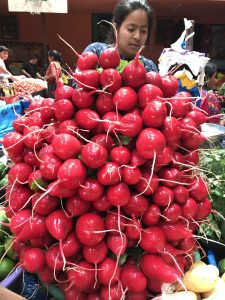 The market at Chichicastenango is truly marvelous. In addition to being organized by areas and having stalls with established locations, there is a tradition of people from nearby areas coming to the market once a week to buy and sell their own products. In some corners of the streets where the market functions, there are signs indicating the name of the street and the market zone, but in many instances the visitor will need to rely on landmarks or other visual clues to get a sense of direction inside the market.
I went to the Chichicastenango market thinking that because it is a typical tourist destination, vendors would be more receptive to giving interviews. Unfortunately, my assumption turned out be incorrect. The owners and sellers at a variety of food stalls were very reluctant to engage in conversation. Some of them asked me to return several times, which I did, but at each instance there was a new reason for not engaging with me. Some of the women were willing to talk but did not allow me to record, photograph, or videotape any of our interactions. I need to return to Chichicastenango and spend more time walking, smelling, tasting, making connections, and learning. It is a magical place.
Yolanda – Chimaltenango
Marta – Chimaltenango
Natalia – Chimaltenango
It is truly a very large and diverse commercial center. It almost seems that the whole city is just a commercial zone. My driver took me to the more traditional market and walked with me at all times. Part of the market is similar to a flea market, where everything one is looking for can be found. In the area of fresh food (fruits, vegetables, meats, etc.), there is an astonishing variety of herbs. Some of them I could recognize; others I had never seen before.
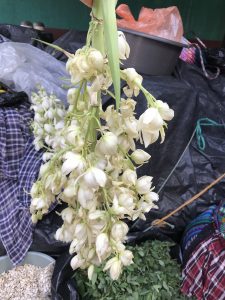
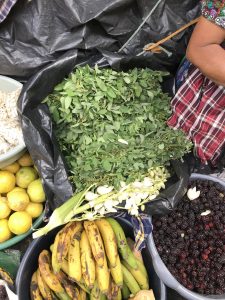 Walking around the market with a man as a guide has some advantages. In terms of safety, I never felt threatened or had the sense that there was any danger. The guide was an excellent way of walking the market without having to think about directions or landmarks, but the masculine presence had a chilling effect in terms of interviewing women. I noticed reticence, caution, and even silence when there was a man observing the interaction. I had the opportunity to chat with women who were selling fresh fruits and vegetables and also with some who were selling prepared foods. In most cases, my interactions were conversations and not interviews.
A young woman who was making tortillas in one of the narrow corridors had her eight-year-old daughter helping her, and she spoke to me while working hard to feed her waiting clientele. Another woman with an established stall at the market was also willing to speak with me, but she did it want me to videotape her or use her name.
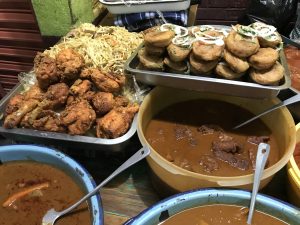 At about noon, my guide and I walked to the main plaza or “zócalo,” another area teeming with food stalls and fresh fruits peeled and cut and ready to take on the road. The stalls had tables and chairs for customers, and many of them had “standing room-only.” It was a busy time of the day for the women who cook and serve, and at these locations, and in spite of many attempts at conversation, I was unable to engage with any vendors.
Plazas or zócalos are ideal spaces for food activities (preparing, selling, eating, etc.). Food is available in the external perimeter of the square. People can walk and enjoy the internal verdant and vibrant part of the square, which offers shade and nice spaces for children to play. The Chimaltenango zocalo is framed by a church on one side, a government building on the other, and is obviously a gathering place for the community.
One can spend many hours in the Chimaltenango market, walking, chatting, looking, learning, shopping. But to learn from the women who work at the market, one needs to engage with them on a sustained, daily basis with the hope of establishing a bond of trust and respect.
Mexico, May to June 2018
Medicinal Herbs – Mercado de Sonora
In such a large city it is obvious that there will be a variety of markets. For example, on the way from the airport to the historic center, one can go through a beautiful flower market called Jamaica. The diversity of flowers and color palette that is visible just with a drive through is astonishing. There are flower arrangements ready for sale and a buzz of people preparing wreaths and bouquets, people walking and examining the different flowers and plants, and of course, the air is sweet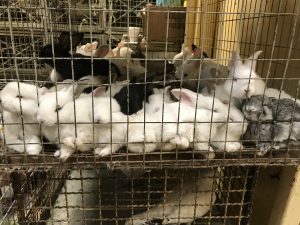
 .
.
This is a short essay about the Sonora market, one of the largest and most popular markets in Ciudad de México. It’s open every day of the week, 9 a.m. to 7 p.m. I walked through the market on Tuesday, May 15, very early in the morning, before the official opening of stalls. I entered through the area dedicated to toys, and the most prominent ones were stuffed animals of any kind one can imagine. The sellers were arranging the toys and setting up for a hot day under yellow tarps.
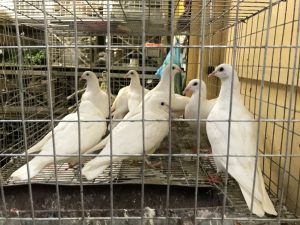
 The isles inside the market are narrow and some of them are not well-lit. I walked through some of the areas were animals are sold. There are pets, like dogs, cats, and birds but also live animals for consumption, such as rabbits, chicken, pigs, and goats.
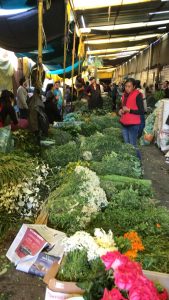 Fresh fruits and vegetables as well as the meats are distributed in several areas of the market with a range of prices and quality. It was surprising to see some of the precut pieces of meats wrapped in plastic, and displayed on counter tops with no refrigeration. These sellers are temporary; they set up every day in a specific area of the market, but they do not have the stability of a stall and refrigeration. In this same area of fresh vegetables and meats there is an abundance of stalls that sell kitchen and food-preparation equipment. From slotted spoons to big grilling surfaces, these stalls cater to the needs of kitchens large and small.
The market is not housed inside a building but rather expands through different streets that keep being added to serve as market places/spaces, so much so, that one can cross the Fray Servando Ave. to other parts of the market through an elevated cross walk.
There is also an area for trash that is inside the market. In fact, trucks full of trash share the roads and small aisles with trucks that carry fruits, vegetables, and other products for sale. I spent most of my time in the herbs and natural-medicine sector of the Sonora market.
 Located in the historic center of the city, the San Juan Pugibet Market is small, almost like a large food court. There are plenty of food stalls to just stop by and grab something to eat while walking and others where one can get a full meal to eat in or take home. The calls offering a taste of the food are friendly and enticing.
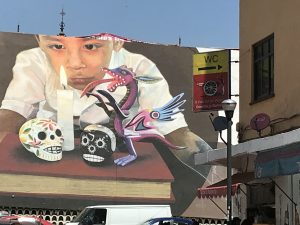
 Walking to this downtown market entails walking through the iconic sites of the historic center, for example the Palacio de Bellas Artes, a magnificent building surrounded by gardens. The walk also involves going through a commercial zone where the activities and the buzz of shoppers and cars are constant. In one of those commercial streets there was a mural that caught my attention.
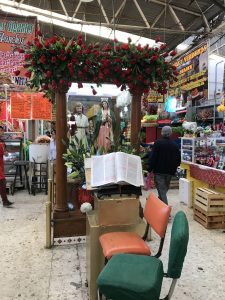
The entrance to the market on Pugibet Street has a stall dedicated to religious images that is enclosed in glass and is decorated with beautiful fresh flowers. Near the religious images there are two chairs and an easel with a Bible.
In this market, in addition to fresh fruits and vegetables and prepared-food stalls, there are other service-oriented business like a dry cleaner, a tailoring shop, an optician. It is obviously an urban market ready to serve the needs of people who live and work in the area.
Ivelia – San Pedro de Cholula
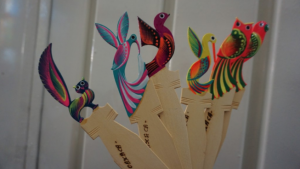
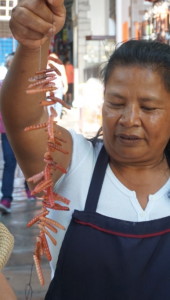 The following day, Saturday, we ventured into the market around 9:30 in the morning just when all the vendors were starting to set up. Many stalls had not yet opened, so it was much quieter and calmer than going in the afternoon when the market is bustling with people perusing the stalls and wares in the tight aisles. We walked in and immediately saw some tiny women in traditional indigenous attire selling little wooden bookmarks and spoons who were walking around and obviously waiting for people to walk into the market. We were able to do some interviews with these ladies, and while we were talking, I noticed the details on their wares. The bookmarks and spoons were smooth and light wood, and the tops were painted and carved into different birds with bright colors and a smooth varnish adorning it. They were beautiful and obviously took some time to create. We saw some of these women in different places later that day, in the zocalo, walking in the streets and again in the market. I remember thinking about how tired I was from walking around and how I could not imagine how exhausting it would be to walk around and try to sell wares you have to carry all day. These women are impressive.
 Later in the afternoon, Kelly and I returned to Benito Juárez when it was busy again to try and find another woman with whom we could have a conversation. Again, we pushed our way through people in the tight space of the indoor market and pushed our way to the outside with the smells of the food and the heat. We talked to a young, beautiful women in an outdoor stall who was embroidering colorful shirts. There were all different hues of purple and pink and orange and blue in the stacks of the neatly folded shirts. The young woman was kind with a manner that was kind and unaffected. She would look me in the eye and smile as she was talking. As with the other women with whom we had spoken, she was a little timid and then really started to expound on our questions and told us about her life and her work.
I think the atmosphere of this market was an interesting location to conduct interviews. On the one hand, it is noisy and busy so you worry that there is going to be too much background noise; however, on the other hand, the market is a prime location because you can kind of just crowd into the stall and talk, like we did with the lady in the afternoon.
Benito Juárez really captured the spirit of downtown Oaxaca. There are splashes of modernity with keychains, postcards, and mass-produced items like purses and wallets, yet there is beauty and originality everywhere with the handmade items, like the bookmarks and embroidered shirts we saw. I could come to Benito Juárez for everything if I lived in Oaxaca, and one could spend hours strolling through and examining all the wares. I felt slightly overwhelmed when we went in the busy afternoon because it is easy to get lost, but it’s a sort of lost where you are almost adrift and wander and explore new alleys and stalls. There was a sensory overload with the bright colors everywhere and smells I am unable to identify. The combination of colors, foods, smells, and people cannot be replicated. I can still picture this market, and I can’t wait to go back and visit this unique and captivating marketplace.
Victoria- San Pedro de Cholula
Irene Santiago Garcia- Benito Juárez
Margarita Perez – Benito Juárez
Yasmine Hernández – Benito Juárez
Rosa – Mercado de Abastos
Sara – Oaxaca
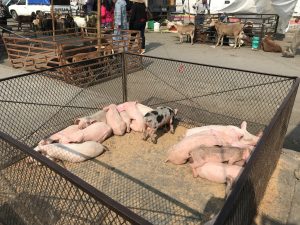
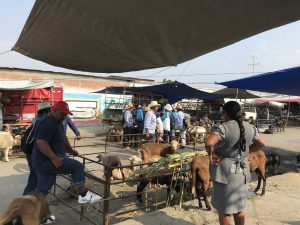 predominantly men, but there are also women, with whom I attempted to talk; they were very busy dealing with their potential clients, and my presence appeared to be a nuisance. There were two sisters with whom I established a short interaction. They had pigs and goats, and from our short and interrupted conversation, I learned that they had always sold animals at the market as part of a family tradition/business. The sun was starting hit their area, so one of the sisters took some long poles out of her truck, and using a rope and a tarp, she created a shaded area for themselves and their animals. After waiting for more opportunities to engage in conversation, Irma and I excused ourselves and continued with our market walk. I would have loved to stay with the sisters through the day, but it was obvious they were not interested in more conversation.
 This Abastos market is vast and has an abundance of products that are sold directly to the customer and also to re-sellers. Irma and I walked the fruits and vegetables area and ran across some of Irma’s friends. This was a perfect opportunity to meet women who work in the market on a daily basis. Among them was one who has been selling her products while finishing her law degree!
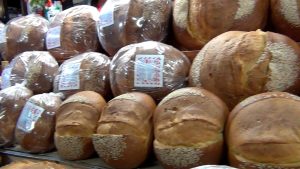 The interior, older part of the market is a more established, old-fashioned building with defined and established stalls. One of these areas is dedicated to selling bread, something I had not seen in other Mexican markets.At least two isles of bread shelves created an area perfumed by the aroma of fresh baked bread, yeast, and sugar. The air calls for eating, and there are so many beautifully appetizing breads that one can’t resist.
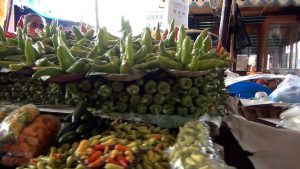 Right next to the breads is an area of chapulines, the iconic edible insects of Oaxaca, with baskets full of chapulines of different sizes. According to my friend from Puebla, Jesús Manuel, the smaller the chapulín the better the taste…I am not convinced.
There is a lot to experience in the Abastos market, but as time pressed on, we started to walk toward the Benito Juárez market, which is located in the downtown near the Oaxaca cathedral, at the center of the social, cultural, and commercial life of the city.
Chocolate and Chapulines(Grasshoppers) – Tlacolula
María Hernandez – Tlacolula
We arrived at the outskirts of the market, and I noticed different stalls and vendors as far as I could see. We began to walk through and immediately were engulfed by these stalls to our left and right, which were about 10 feet wide and 8 feet high, often having a tarp or cloth roof protecting the merchandise. The first part of the market was filled with different types of food. Carts with Pineapples stacked 10 feet high, pyramids of tomatoes, peppers, mangos, and avocados by the hundreds, as well as mountains of cilantro flooded the market. 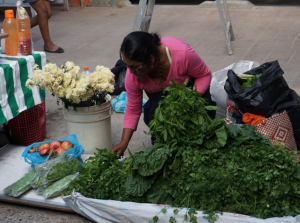
As we made it through the food I began to see a glimpse of modernity. Stalls with items such as sunglasses, t shirts, and CDs appeared before me. What really caught my eye, however, was the contrast between these items, and the vendors. While many the vendors were wearing more modern clothing such as a blouse or collared shirt and jeans, some were not. In particular, many of the indigenous women I encountered had beautiful ornate dresses and skirts on. Their clothing was vibrant and exquisitely detailed. Along with rich blues and pinks woven into their blouses, many women also wore thin silky head scarves detailed with flowers. Alongside many of these women I noticed stalls of their handmade shirts, beaded jewelry, and tapestries. 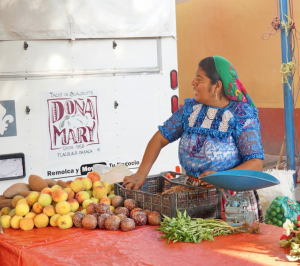
Once I got deeper into the market, I found myself in front of a large building that was filled with hundreds of more vendors. This building encompassed sections with huge pieces of meat hanging from PVC pipes, other sections with heaps of bread, and others with various pieces of handmade art. One aisle was filled with different indigenous women sitting on the floor surrounded by hedges of multicolored flowers and plants. As I walked through this building, pungent smells entered into my nose. First the sweet smell of bread, then the startling smell of raw meat, and finally a breath of fresh air as I passed through the freshly cut flowers.
Through my interactions with the vendors and watching them as they set up their stalls, I could tell that they worked hard. Repeatedly as people would walk passed their stalls, they would try to get the attention of the consumer by assuring them that they had good prices and good quality items. Also, it was very hot outside. But they continued working.
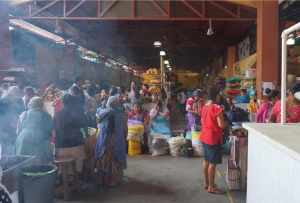 As I sat inside of one of the stalls and talked with two indigenous women, my eyes opened even more to their incredible talents, strength, and resilience. These women told me of the 12 hour journey they took each week to get to the market. They told me of the hours of work and practice they put in to get to the skill levels they are currently at. I cannot express how much of an honor it was sitting and listening to these women tell me about their lives and histories. Getting to hear about their passions, struggles and successes changed my entire perception of them, and gave me a deep appreciation for their lives and culture.
Peru, February to May 2018
A food vendor shares her observations about how increasing tourism has affected her life and her family.
Raquel Laura – San Blas
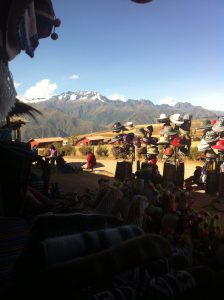 our seats), jugs to collect chicha, and all of the vendors of the small community. It is now the dry/cold season, and for the hour that we descend into the valley there are murmurs of ‘chiri’ and ‘alalow’, expressions of cold in Quechua, the first language of most highlanders in Peru. The women wrap their heads and shoulder with their blankets, which in the afternoon will become their grocery bags. As we travel, we collect more and more people from the side ofthe road who are making the journey to the market. My first time riding the truck I could not believe that the truck bed could possible fit more people, but every five minutes I was proven wrong. In most contexts 28 people doesn’t seem like a lot. But when myknees are smashed to my nose, a bag of guinea pigs is squealing in terror at my feet, and a pig is struggling her ties in the nearest corner, 28 people can be counted as too many for one truck. However, I cannot deny that the truck bed is a place of community as well. Multiple times an awicha (grandmother) would share her shawl with me. The children are always protected from the cold between knees or potato sacks until they are dropped at the school and every vendor loves her chance to flirt with the driver, Joel.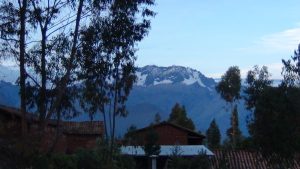
The market of Urubamba is a claustrophobic place, reminiscent of the truck-bed. Like the women from Kacllaracay, the vendors travel from every corner of the Sacred Valley to sell their weekly harvest.The farmers sell their potatoes, wheat, beans, quinoa and corn. If you arrive in the morning, look out for the heavy sacks riding each pair of shoulders, for you never know when or where they are going to fall. Some merchants will spend the whole day walking through the market with their goods, perhaps herbs like chamomile or coriander, only to go home with a few coins. Among all the vendors in Urubamba are the 28 from Kacllaracay, and in contrast to the lack of space in the truck, when we arrive at the market, the women quickly disperse into the hundreds of other people. They hurry to buy their groceries, to eat a coveted meal of chicken or beef broth, or to meet up with their family from other communities.
Miriam Atau Pilco and Elva Enríquez Quispe- Moray
Yolanda Rivera Huanca – Urubamba
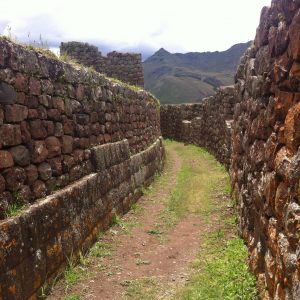
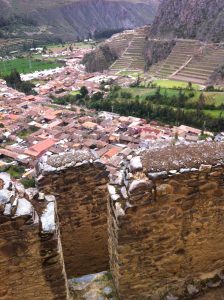 Walking through the stone corridors from the plaza of Ollantaytambo, the noises of the Choquekilka festival follow me, echoing. This weekend the town will celebrate the Pentecostal holiday along with the season’s first harvest. Spanish music floats from each block of the town and if you turn a corner, there will probably be a dance troop shining in their outfits of bells and flowers. It’s impossible to walk through the plaza at this time, but if you go early enough to find a seat, the dancers visiting from the peaks surrounding the basin of Ollantaytambo will offer food cooked with the first harvest; corn with salty Andean cheese, sheep’s head soup, quinua porridge, or pumpkin soup. Undoubtably there will be chicha, an ancient beer, fermented from corn and the shining star of every Andean party.
 Every vendor is prepared for the torrent of customers that will flood the market this weekend. The merchants and their goods have poured out of the three-story market onto the sidewalk as the food stalls have multiplied. Merchants who are traveling to the Choquekilka festival spread their shawls
 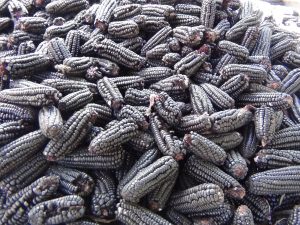 on the sidewalk outside and cover it with apples, potatoes, or oca (an Andean tuber). People have brought special treats for the festival; churros and canchitas (homemade Andean popcorn), and the women have chicha of all different flavors, purple corn, strawberry, or carrot. Out of curiosity and because of the brilliant orange color, I buy a plastic pint of carrot chicha for one sol (about 30 cents). I want to talk with the vendor about the excitement of the weekend, but it’s obvious that she doesn’t have the patience. She scans the market interior searching for more clients. I hand the empty cup to her, which she silently dips in a bucket of water to rinse for the next customer
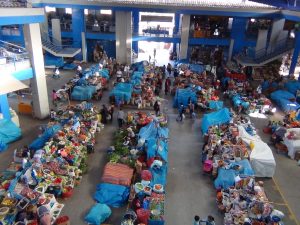 The market of Ollantaytambo has produce on the ground floor, clothing and toys on the second, and I find lunch among the stalls on the third. Every food stand has the same options, chicken soup, lomo saltado (beef stir-fry), Cuban rice, crispy pork, or french fries. I choose the arroz cubano, a plate of eggs, rice, plantains, and no beans because of the difficulty of digestion at this high altitude. Every bite is complimented with a drop of uchucuta, an orange chilli sauce. I give a nod of thanks to the chef and descend to the party in the plaza, one block away.
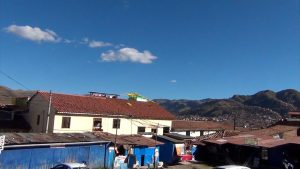
I remember one day in particular when, breathless, we arrived in the plaza of San Blas and entered the market. This market is filled with light and has a small garden in the center. People throw the seeds and peels of fruit into this garden, which fall beneath the orange flowers. In the back of the market they sell prepared foods, with a surprising quantity of vegan stalls. Without hesitation my three friends and I approach our favorite restaurant. Angelica and Raqual Laura greet us with “hola, amigas!” and pass menus across the counter, though we already know what we want. Raquel Laura prepares juices, one after another: maracuyá and mango, strawberries and milk, green juice.
Angelica sells sandwiches for the price of 4 soles. For the equivalent of 1 dollar one can get a greasy, well-sized sub of vegetable, eggs, and melty Andean cheese. Usually, Raquel Laura drives the conversation here, but when I come here alone, without the other gringas, Angelica is happy to talk. With a bit of trepidation, she allows me to use my voice recorder while we talk about her work in the market and her life at home.She shares her small daily activities and thoughts, and eventually the grander events of her life, sometimes with a smile alongside her tears. We part with a wave and a better knowledge of each other, me wondering if we will see the other again.